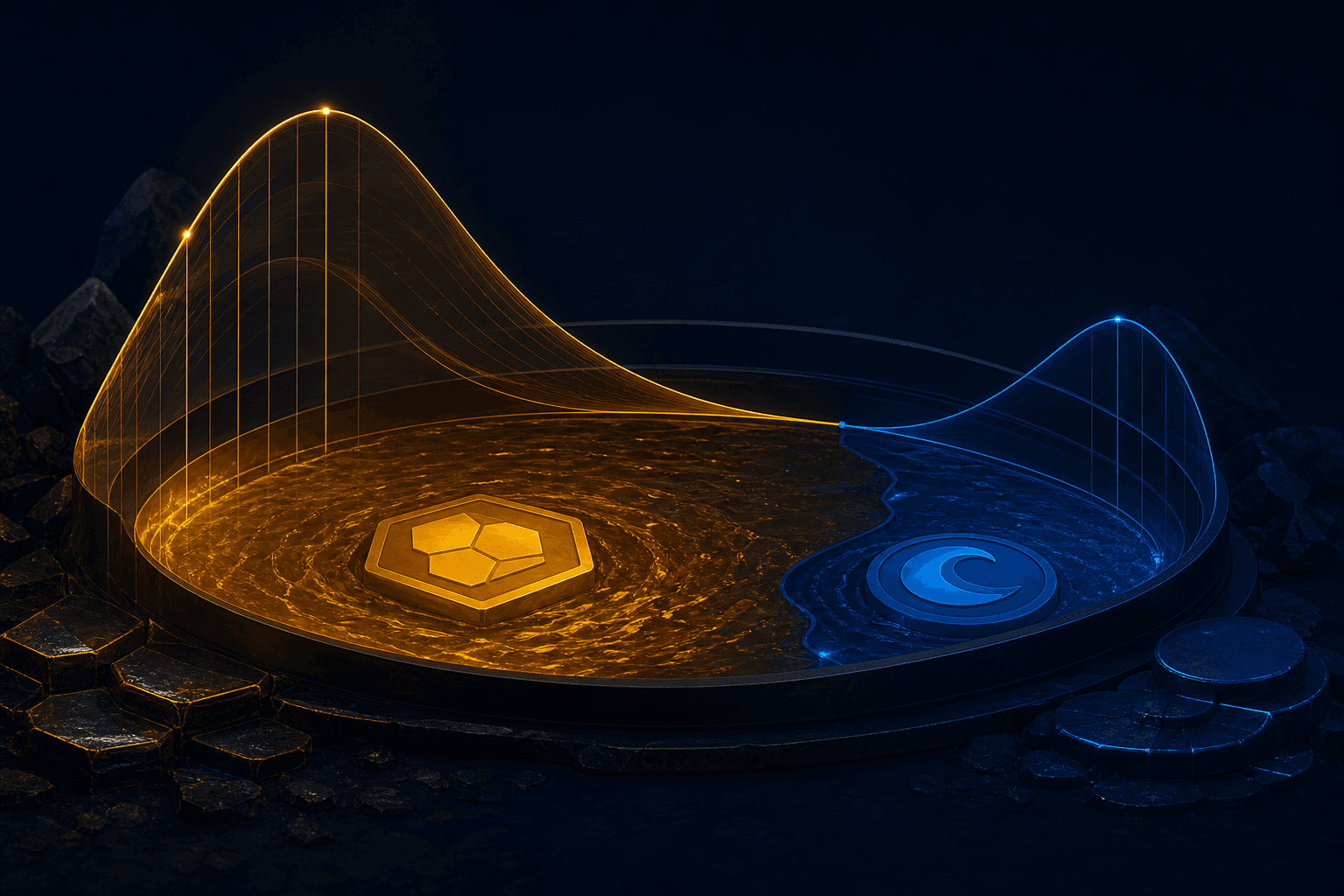
TIDE is now live on Ethereum. Three weighted pools — HEX Chips, Bluechips, and King TIDE — give Bitcoin and Ether holders a self-custodial path to rotate into HEX and HEX-related assets on the chain HEX launched on.
HEX has always been an Ethereum-origin asset. The friction was never the idea of holding it. The friction was getting there from BTC and ETH without a centralized exchange, a messy bridge hop, or a thin HEX book. TIDE on Ethereum is built for that rotation.
TIDE is Coast's Balancer V3 DEX. On PulseChain it already runs weighted pools such as the 80/20 HEX/CST Buy HEX pool. That same pool design — custom weights, lower slippage than a forced 50/50 split, liquidity that can overweight the asset people actually want — now sits on Ethereum mainnet.
What launched
Three weighted pools are live on Ethereum. Switch the network to Ethereum at 0xtide.com/pools.
HEX Chips — 60% HEX / 20% USDC / 10% WBTC / 10% WETH
The rotation core in one pool. HEX is overweight so BTC, ETH, and USDC holders can buy HEX with less HEX-side slippage than a forced 50/50 pair. Bitcoin on this pool is WBTC. Open HEX Chips on TIDE.
Bluechips — 40% WBTC / 40% WETH / 20% USDC
BTC and ETH inventory with dollar ballast — no HEX leg. A place to sit in the two largest crypto balances plus a USDC sleeve before or after a HEX rotation. Open Bluechips on TIDE.
King TIDE — 80% TIDE / 20% WETH
The protocol-token pool. Same 80/20 design language as PulseChain TIDE, priced against Ether on mainnet. Open King TIDE on TIDE.
Together HEX Chips and Bluechips are the minimum viable market for a HEX rotation venue: the asset people want (HEX), the two largest crypto balances people already hold (BTC and ETH), and a dollar stablecoin to price and stage the trade. King TIDE is the protocol book beside that rotation set.
This is not a new HEX. It is a better door into the HEX that already exists on Ethereum — plus a path from BTC and ETH that does not require giving a custodial exchange your coins.
Why BTC and ETH holders needed this
Most BTC and ETH holders who want HEX exposure still hit the same wall: HEX is thinly served on the large centralized venues, and Ethereum HEX liquidity has historically been scattered. PulseChain has a deep HEX culture — staking, index products, Coast's CST on-ramp — but that does not help someone whose stack is still on Ethereum mainnet and who is not ready to bridge.
TIDE on Ethereum keeps the rotation where the capital already sits.
- BTC holders can move wrapped Bitcoin into HEX without opening a CEX account that lists HEX (many still do not).
- ETH holders can swap native Ether into HEX in a HEX-native venue instead of routing through unrelated pairs.
- USDC holders can stage a dollar entry into HEX, or exit a HEX position to a stablecoin, in the same pool set.
- HEX holders get a dedicated Ethereum book next to the PulseChain TIDE pools they already know.
That last point matters for Heart's Law: interchangeable HEX markets are bonded by the liquidity in their pairs. HEX Chips — HEX priced against BTC, ETH, and USDC in one weighted pool — is not a side quest. It is how HEX on mainnet is allowed to price against the assets people actually hold.
How TIDE pools differ from a typical 50/50 AMM
TIDE uses Balancer V3 weighted pools. You are not locked into a 50/50 split. A pool can overweight HEX so that:
- Traders buying HEX with ETH, BTC, or USDC see less slippage on the HEX side when the pool is HEX-heavy.
- Liquidity providers who are structurally long HEX take a different impermanent-loss profile than they would in a 50/50 HEX/ETH or HEX/USDC pair.
The PulseChain Buy HEX 80/20 HEX/CST pool is the worked example: overweight the destination asset, use the other leg as the on-ramp inventory, accept the IL trade-offs in writing. Ethereum TIDE applies the same design language to BTC, ETH, and USDC as the source legs.
If you want the formula-level IL comparison (80/20 vs 50/50 when the overweight asset doubles or 5x), that math lives in the PulseChain deep dive. The principle does not change on Ethereum.
How to use it
- Open 0xtide.com/pools with Ethereum selected.
- Connect the wallet that holds your ETH, WBTC, USDC, HEX, or TIDE.
- Use HEX Chips to rotate into HEX, Bluechips for BTC/ETH/USDC inventory, or King TIDE for the protocol token vs Ether.
- Swap — or provide liquidity if you intend to earn fees on that flow.
PulseChain TIDE is unchanged. If your path onto HEX still starts with fiat, Coast's on-ramp and CST remain the PulseChain door — see how to choose a fiat on-ramp and how CST and stablecoins work. Ethereum TIDE is for capital that is already on-chain in BTC, ETH, USDC, or HEX.
New to the ecosystem? Start with the Get Started guide, then come back to TIDE when you are ready to swap.
HEX and HEX-related assets
HEX Chips is the rotation core. Bluechips holds the BTC/ETH/USDC book without HEX. King TIDE is the protocol token vs Ether. HEX-related assets — the derivatives and satellite markets that price off HEX — belong on a HEX-native venue once HEX itself has a real Ethereum book. TIDE's job on day one is the parent market: get HEX liquid against the three balances people actually hold, and give TIDE its own mainnet pair.
For the longer HEX / BTC / ETH relationship, the 2021 essay Why Bitcoin, Ethereum and HEX are skyrocketing is still the right framing: these are not interchangeable memes. They are different monetary machines. A pool set that prices them against each other is how a rotation actually happens instead of remaining a Twitter opinion.
What this is not
- Not a CEX. You connect a wallet. TIDE does not custody your keys.
- Not a Coast App buy button. 0xcoast.com is the umbrella brand. Trading happens at 0xtide.com.
- Not investment advice. HEX, BTC, and ETH are volatile. Liquidity provision has impermanent loss. Smart contracts can fail.
- Not a PulseChain replacement. Ethereum TIDE sits beside PulseChain TIDE, not on top of it.
FAQ
Is TIDE live on Ethereum?
Yes. TIDE is live on Ethereum mainnet with three weighted pools — HEX Chips, Bluechips, and King TIDE — alongside the existing PulseChain deployment.
Which pools launched on TIDE Ethereum?
HEX Chips (60% HEX / 20% USDC / 10% WBTC / 10% WETH), Bluechips (40% WBTC / 40% WETH / 20% USDC), and King TIDE (80% TIDE / 20% WETH).
Which assets can I swap on TIDE Ethereum?
HEX, BTC (WBTC), ETH, USDC, and TIDE. HEX Chips is the rotation pool into HEX. Bluechips holds BTC, ETH, and USDC with no HEX leg. King TIDE is the protocol token vs Ether.
Do I need a centralized exchange?
No. Connect a wallet on Ethereum and swap through TIDE's weighted pools. Coast does not take your keys.
Is the BTC pool native Bitcoin?
No. Native Bitcoin does not live on Ethereum. The BTC leg is the wrapped Bitcoin used in Ethereum DeFi (WBTC).
Does this replace TIDE on PulseChain?
No. PulseChain TIDE remains live, including the HEX/CST on-ramp pool. Ethereum is an additional venue on HEX's origin chain.
Trade on TIDE: Ethereum pools at 0xtide.com. Read the ecosystem context on the TIDE project page.
Educational content only. Not financial, legal, or tax advice. Swaps and liquidity provision involve smart-contract risk, market risk, and possible impermanent loss. Only use funds you can afford to put at risk, verify the network before you sign, and never share a seed phrase.